

Sports & Event Tech · Morocco
Ticketing saved up 30% with cloud migration
The Challenge
The client operates Morocco's largest multi-club ticketing platform, handling seat sales for top-tier football clubs. Their
infrastructure ran entirely on-premise - which worked fine on quiet weeks, but became a critical liability on match days.
During derbies and high-stakes fixtures, traffic would spike massively and without warning, bringing the servers down at
exactly the worst moment. Fans couldn't buy tickets, clubs lost revenue, and the client lost trust.
The second problem was cost: on-premise servers meant fixed monthly expenses regardless of actual usage. During the
off-season, championship breaks, or summer vacations, they were paying full price for idle capacity with no way to scale
down.
Scaling up or down was also entirely manual - slow, risky, and dependent on human intervention. And on top of all that, the
platform was exposed to attacks during high-visibility events, with no dedicated protection layer.
The Goal
Migrate the entire infrastructure to the cloud to eliminate server crashes on peak traffic days, move from fixed to
variable costs, enable automatic scaling in both directions, and protect the platform against attacks - all without
interrupting an active ticketing season.
Our Solution
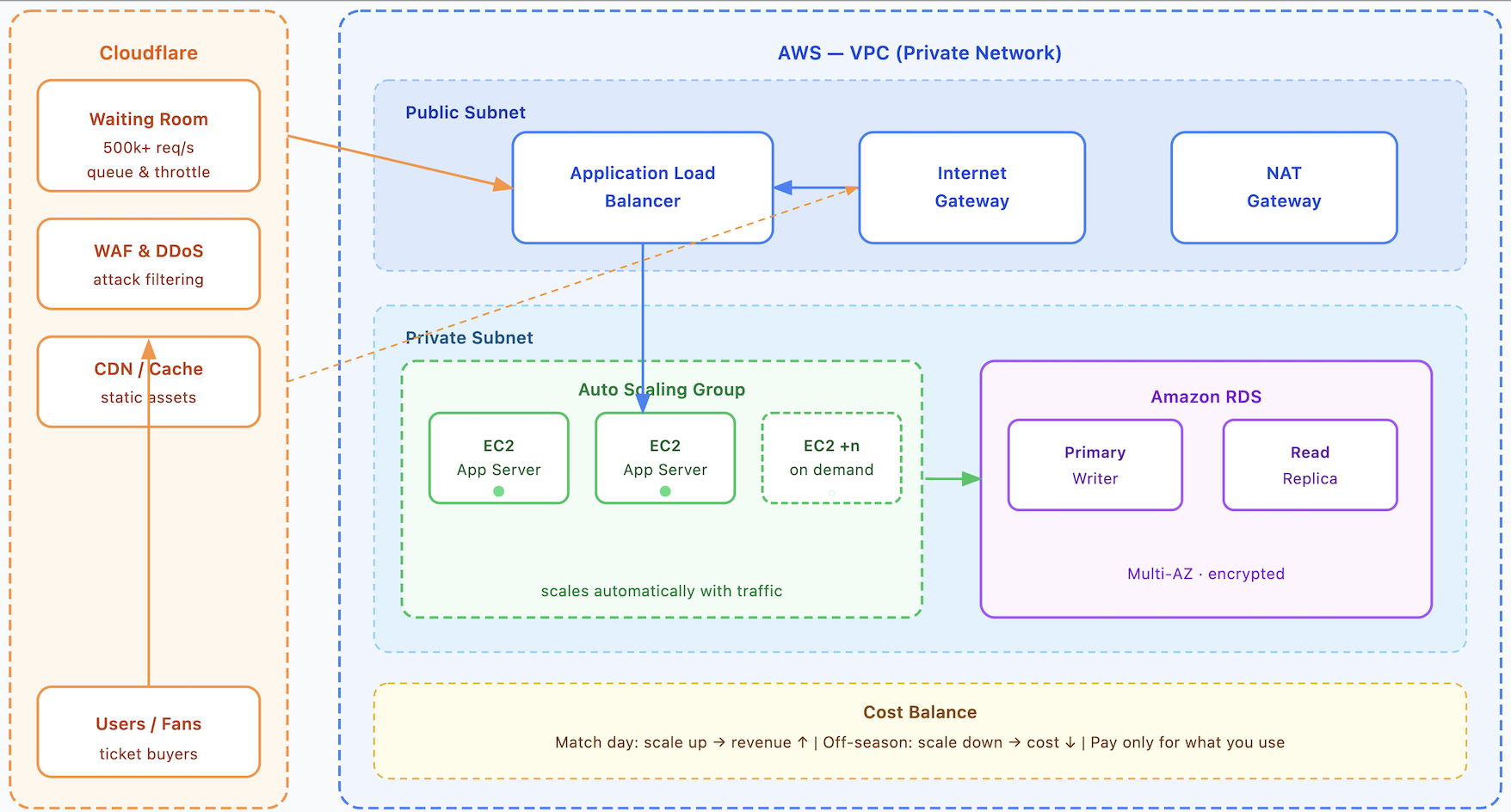
We designed and executed a full migration from on-premise to AWS, running entirely within a private VPC network - no public
exposure of application or database layers.
We deployed Auto Scaling Groups behind an Application Load Balancer, so the platform scales automatically with traffic -
spinning up new instances in minutes when a derby goes on sale, and scaling back down once the rush is over.
To handle traffic spikes exceeding 500,000 requests per second, we integrated Cloudflare Waiting Room - users are queued
before reaching the infrastructure, preventing overload while keeping the experience smooth.
The database was migrated to Amazon RDS with read replicas to absorb the surge of concurrent reads. Cloudflare WAF and DDoS
protection filter malicious traffic upstream before it ever reaches AWS.
A key outcome is the cost balance: infrastructure scales up on match days when ticket revenue is at its peak, then scales
back down during off-season and championship breaks - turning a fixed cost into a variable one aligned with actual business
activity.
Results
Since migrating to AWS, the platform has handled every major fixture and derby without a single server outage. Traffic
peaks exceeding 500,000 requests per second are now absorbed seamlessly through Cloudflare Waiting Room, which queues fans
in an orderly flow before they reach the infrastructure - protecting the system at its most critical moments.
Auto Scaling has fundamentally changed the economics of the platform. During high-demand events, new instances spin up
automatically within minutes to meet the load. Once the rush subsides, the infrastructure scales back down - meaning the
client pays only for what they actually use. Compared to the previous fixed on-premise costs, infrastructure spend during
off-season and championship breaks has dropped by approximately 40%.
The entire application and database layer runs inside a private VPC, with no direct public exposure. Combined with
Cloudflare's WAF and DDoS filtering upstream, the platform now has a layered security model that has successfully blocked
attack attempts during high-profile match days.
The migration was completed with zero downtime during an active ticketing season - users experienced no interruption in
service throughout the cutover.
Photos